Posts

Cyberbullying: Ew

Image
makeameme.org Cyberbullying. What is there left to say? I've really spent some uncomfortable hours sitting with the topic this week, and rather than feeling better equipped to prevent or effectively address the issue, I feel disheartened about its indissoluble nature and seeming inevitability. THANKS, DR. GREEN! 😉   I appreciate the framing from this week's Faucher et al. piece of cyberbullying as repeated behaviors intended to cause harm and born out of a desire for or assertion of power. Is one mean text or mean-spirited social media post cyberbullying, maybe not, but it could be indicative of a deeper and budding pattern of abuse, and we have little hope of eradicating the weed if we do not first locate and pull it out by its root. Studying those roots can tell us how the organism of cyberbullying grows and thrives, so that we are better equipped to combat its spread. But wow, is that a daunting challenge. In terms of appeal and consequence, cyberbullying is like any other...

Ask not what you can do for the 'gram, ask what the 'gram can do for you (Social Media as Advocacy Tool)

Image
"Librarians and library workers who serve teens know that staying up on trends, including those related to social media and marketing, is just part of the job" (Wetta, 2016, p. 32).  There's a meme format with which you might be familiar: wanna feel old? This particular meme always begins the same way, but has launched countless create-your-own endings aimed at reminding their readers that something which may feel like a recent memory actually happened long ago ("long" being relative to each iteration of the meme, of course). I think it's safe to say that, in the unlikely event you do find yourself wanting to feel old, spending a few minutes with middle school students is just the ticket. Their interests, role models, fashions, inside jokes and cultural references are nearly all inspired by or integral to the online content they consume and the social media platforms they use. If you are already keeping up with the who, what, when, and wheres (can the 'w...

Britannica Online School Edition: Enhancing Student Research Capabilities with Adaptive Technology

Image
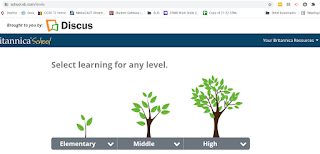
Britannica Online is a database of encyclopedia articles on a wide array of topics, compiled for use by k-12 students. Users may search for articles, videos, images and other resources to enhance their learning, and explore hundreds of thousands of digital articles replete with vetted, trustworthy information. Britannica Online offers learners and educators access to quality research resources and improves teaching and learning outcomes inclusively and equitably through the use of curated, customizable features and functions. In South Carolina, Britannica Online access has been granted to public school k-12 students across the state. Learners and educators may navigate to the database from their school or library website, or through MackinVIA, a digital resource management system, but should also be able to sign in by navigating directly to  https://school.ebonline.com/ . Students then have the option to select Elementary, Middle, or High School level access to begin their research...

Technology and Pedagogy and Integration Models, Oh My!

Image
Technology integration in K-12 learning environments is an ever-evolving science. When I think back to the types of technology I recall from primary school in the mid-1990s and early 2000s, I picture overhead projectors, big, boxy televisions wheeled into the room on tall metal carts, and classrooms with no desktop, laptop, or tablet computers in sight. Who needed them? There was a computer lab on the Related Arts hall that classes got to visit once each week (to practice keyboard and typing skills, or, perhaps as a treat, play a rousing game of Oregon Trail)!  Today's classrooms and common learning areas resemble the classrooms of my youth in many ways, but the technology landscape is nearly unrecognizable. Students may all be issued their own personal tablet or device to use for school work, classrooms come outfitted with interactive tech tools for use by teachers and pupils, and school libraries have blossomed into information and technology hubs that serve the diverse array of ...

Creating Quizzes in Google Forms: Guidance for Teachers and Collaborating Librarians

Image
 For the third consecutive school year, we are navigating the challenges of teaching during a pandemic, which renders long-term plans moot, and adaptability to changing circumstances absolutely essential. In extreme cases, teachers do not know from one day to the next how many students will be cleared to enter the classroom, or for how long others may be home sick or on quarantine. Having a flexible game plan is the best way forward for us as educators, and we must all modify instruction and curriculum plans to accommodate the array of student needs that persist. Utilizing digital learning tools empowers teachers to connect consistently with their students, evaluate their progress and identify pain points in the learning process. In my school, as is likely the case at yours, some teachers and students are new to the Google suite of services, or simply newly interested in exploring its many useful tools and features. Google Forms offers teachers the ability to create and score quizz...

Information and media literacy: it's a bitch (I mean bitch in gender neutral terms)

In reading and researching this week I came across a germane analysis of the Association of College and Research Libraries' (ACRL) information literacy framework, in a piece from the Institute of Electrical and Electronics Engineers (IEEE). Professor Cliff Lampe (2021) writes: This framework focuses more on the dynamic nature of information, the constructed and contextual nature of authority, and information literacy as an ongoing, strategic process in which people engage. This avoids the problems of less complex methods by teaching people to think more deeply and critically about the information they receive, and by rejecting simple ideas of what is true or false (para. 3). I appreciate how concisely Lampe identifies both context for and considerations made in generating the ACRL framework. His explanation pinpoints so many of the big ideas of effectively teaching young learners how to practice and prioritize information literacy. Information on any number of topics, and from the ...

AASL and ISTE Standards: Common Denominators, Core Differences

  AASL and ISTE Standards: Common Denominators, Core Differences According to the AASL, their National School Library Standards are designed to "help school librarians establish effective school libraries, and provide goals to advance programs and prepare students (K-12) for college, careers, and life" (AASL, n.d., Research Objectives). Their most recent Standards update aims to empower school librarians with a common framework to apply to and inform their work. The revised Standards still identify all the same common beliefs inherent to the profession, and both these beliefs and the Standards themselves revolve around the 3 components of the school library: the library itself, the community of learners served by the library, and the librarians whose job it is to connect learners with information resources in an ever-evolving learning environment. Standards are integrated for all 3, and they are composed of 6 shared foundations with a framework for each of the 6. 4 domains (t...